FAQ
Most Asked Questions
FAQ - Reverse Osmosis
Q1. How does Reverse Osmosis differ from a Water Filter?
Ordinary water filters use a screen to separate only particles of dirt sediment from water. Reverse osmosis employs a semipermeable membrane that removes not only particles but also an extremely high percentage of dissolved contaminants-molecule by molecule- from raw tap water.
Information from Water Supplies Department of HKSAR
- NSF 58 filter employs reverse osmosis for contaminants removal by forcing water through a semi-permeable membrane. Most reverse osmosis systems incorporate one or more additional filters on either side of the membrane. NSF 58 certified filters1 are able to removal all the six metals viz antimony, cadmium, chromium, copper, lead and nickel which may be present in the plumbing system. Consumers should check the NSF 58 certification before buying a reverse osmosis filter.
- NSF 53 filter employs adsorption for removal of soluble contaminants and filtration for solid particles. Carbon filters are an example of this type of product. For the 4 metals viz cadmium, chromium, copper and lead which could be present in internal plumbing systems, consumer should check whether the filter has obtained the appropriate NSF certification for reducing the concerned metal before buying the filter.
Q2. What is PurePro Home Reverse Osmosis System?
PurePro RO Systems is a Home Drinking Water System that uses the principle of reverse osmosis to remove 95-99% of all the mineral and chemical contaminants from raw tap water. PurePro products gives you the quality of bottled water with the convenience of a faucet mounted on your kitchen sink.
Q3. What is the RO membrane and how does it work?

The membrane consists of several thin layers or sheets of film that are bonded together and rolled in a spiral configuration around a plastic tub (This is also known as a thin film composite or TFC membrane.) The material of the membrane is semipermeable : it allows water molecules pass through while acting as a barrier to dissolved solids (i.e.: mineral chemical contaminants). When the feed water stream passes across the surface of the membrane, the PurePro molecules penetrate the membrane surface, working their way around the spiral and collecting in the center tube. The remaining contaminants are concentrated and washed from the surface of the membrane down the drain.
Q4. What is the actual process of the PurePro Home R.O. System?
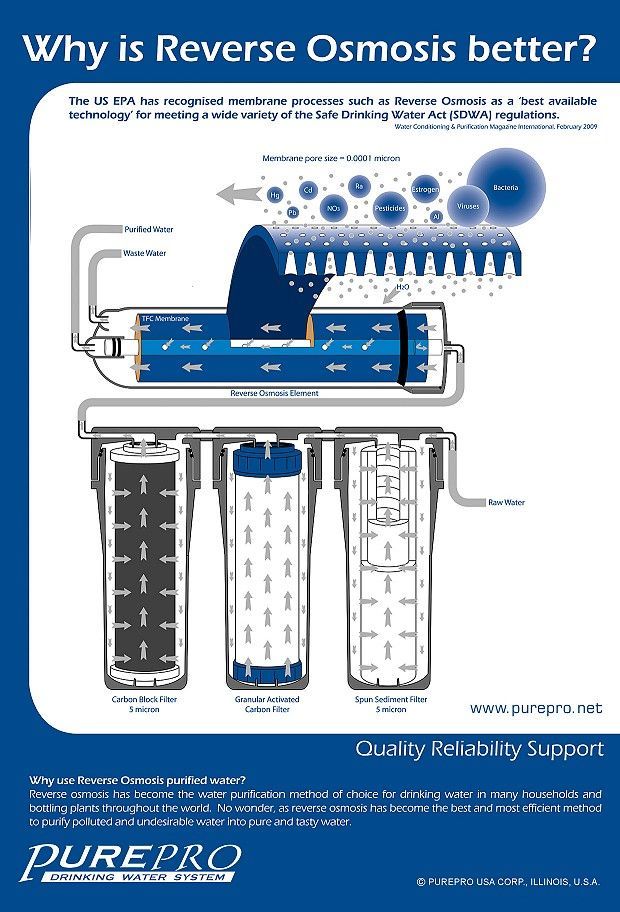
The raw tap water first flows through a 5 micron particle FILTER[1] to remove dirt, rust and other sediment. The water then flows into a carbon briquette cartridge FILTER[2] which takes out 98% of the chlorine and organic chemicals. The next stage of the process is FILTER[3] 1 micron sediment filter or the Block carbon filter to filter multi-chemical compounds and suspension. [4] The reverse osmosis membrane (TFC) which will separate 95-99% of the dissolved contaminants from the water molecules.
The contaminants are then washed down the drain. The next stage of the PUREPRO RO SYSTEMS process is the small CARBON FILTER [5] removes the remaining traces of chemicals, tastes and odors. Typical Flow Chart The R.O. water is stored in a 3.2 gallons TANK[6]. Inside the tank is a balloon-like rubber diaphragm, pre-charged with 8-10 psi of air. As the tank fills, the air pressure increases and pushes the water out when the faucet is opened. The final element of the PurePro Series system is a POLISHED CHROME FAUCET [7]. It is installed on the kitchen counter or the sink. It is a dual action faucet offering intermittent flow (to fill a glass, hold the handle down) or continuous flow (to fill a coffee pot, lift the handle up).
Q5. How did Reverse Osmosis get its start ?
Although the idea of reversing osmosis has been known for over 10 years, the practical application is a recent development. In 1962 the U.S Government funded the first R.O. plant which processed 1000 gallons clean water per day. Today, there are more than 3000 large R.O. treatment plants, each producing more than a million gallons of drinking water each day. In 1991, the U.S. Army bought 8,000 large membranes to their mobile water purification units for troops in Desert Storm. In 1993, the U.S. Government bought another 6,300 large membranes to purify flood water in the Midwest.
Q6. Will R.O. remove Sodium from the water ?
YES! Reverse Osmosis was originally designed to make sea water drinkable for the navy. It is ideal for anyone on a low sodium diet.
Q7. Does R.O. remove Bacteria ? Cryptosporidium ?Legionnaires?
YES! An R.O. membrane has a pore size much smaller than bacteria virus, pyrogen or the cryptosporidium parasite, even though legionaries which only RO membrane can segregate from water. When functioning properly it will remove all microorganisms from tap water and produce sterile water.
Q8. What does the PurePro series drinking water taste like?
The taste of the PurePro water depends on the amount of contaminants in the tap water originally. If 95% of dissolved minerals and chemicals are removed, the R.O. water may taste like distilled water (no minerals), bottled water (low mineral), or natural spring water (moderate mineral content).
Q9. How will the PurePro series water affect mixed beverages?
Because reverse osmosis removes invisible contaminants that mask flavor, it allows the natural taste of your beverages to come through. You will be able to use less coffee and still get the full flavor. Concentrated beverages like orange juice will taste tangier. You will probably be drinking a lot more water as well, since many people drink soda, Kool-Aid, concentrated juices, and beer as an alternative to bad-tasting tap water. Also, PurePro eliminates most of the lime build up on drip coffee makers, preventing the need for frequent cleaning. No longer will you find the white scum on the inside of pans after boiling water.
Q10. Don't people need minerals removed from the water?
Most of the minerals that we receive are from the foods we eat. Only a very small percentage comes from the water we drink.
Q11. Where is the PurePro series drinking water system installed?
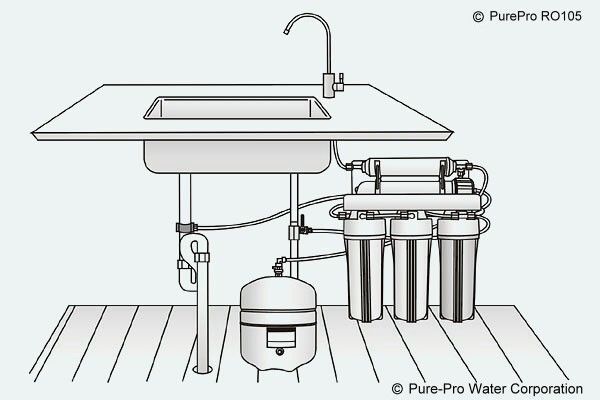
The PurePro System is usually installed underneath the kitchen sink. So installers prefer to locate the equipment in the basement or in a crawl space since the water may stay cooler there, and can be easily run up to the kitchen sink, as well as to a refrigerator & additional faucets in the home.
Q12. Can the Purepro system be connected to an extra faucet ?
It only takes a 1/4″ tee and tubing to run the water to a refrigerator or an extra faucet or dispenser. Some families run PurePro system to all of their bathrooms and some office run to all dispenser or boiler, even coffee maker too.
Q13. What factors affect the quantity and the quality of the water produced?
There are four major variables to consider:
PRESSURE. The greater the water pressure, the better the quantity and quality of the water produced. Water pressure of 60 psi ideal. PurePro include one booster pump can make sure the water pressure.
TEMPERATURE. 76*F is the ideal water temperature for R.O. 40*F water will cause the production of R.O. water to fall to half of that at 76*F. The maximum water temperature recommended is 85*F.
TOTAL DISSOLVED SOLIDS (TDS). The higher the amount of dissolved contaminants in the water, the lower the quantity of water produced. A high level of TOTAL DISSOLVED SOLIDS can be overcome with additional water pressure.
MEMBRANE. Different membranes have different characteristics. Some produce more water than others; some have better contaminant rejection capabilities; some have greater resistance to chemical abrasion for longer life. PurePro Hong Kong comes with TW30-1812-100 The Thin Film Composite(TFC) membranes combine the best of these characteristics and are considered the finest membrane in the world.
Q14. How much water does the Purepro system produce?
Under ideal conditions, the TW30-1812-100 TFC membrane is rated at 100 gallons (378 liters) of production per day (100gpd at 80~100psi). Under the average conditions, the consumer can expect 90-105 gallons (340-396 liters) of product water per day. But that’s still a lot of water for the average household’s drinking and cooking requirements.
Q15. Can the amount of water produced be increased?
Yes. There are several ways:
At night, fill a pitcher with water from the tank. The emptier the tank the faster the water production. By morning the tank will be filled with fresh water.
A second membrane can be added. An additional membrane is required to double the capacity of the PurePro System.
Q16. What is the guarantee on the PurePro System?
PurePro Hong Kong is guaranteed PurePro System installed at Hong Kong and Macau for 3 years for material and workmanship (excluding filters). All defective parts will be replaced free within three year.
Q17. What is the maintenance schedule for the PurePro System?
PurePro Hong Kong will provide a suitable maintenance schedule to each customer. Normally the three pre-filter cartridges will be changed depend on usage and building condition. The first is a 5 micron sediment cartridge. The second is a Carbon Cartridge. The third is another Cartridge. (some system comes with the 1 micron sediment.)
Failure to change the cartridge may reduce water pressure by mud or sand and also chlorine will destroy the RO membrane,
so RO membrane will change periodically by us. Our Technician also will check it’s condition by very visit. Or you may advise us, once you notice a different taste or more white scum on the inside of a pan of water you are boiling. This might mean the R.O. membrane is disintegrating and requires replacement.
Q18. What contaminants do Reverse Osmosis Remove?

The PurePro System contains a quality carbon filter which will remove more than 98% of organic chemicals from the water. These include THMs(chloroform), DBCP, lindane,
TCEs(trichloroethylene), PCEs(tetrachloroethylene), carbon tetrachloride chlorine, In addition to these organic chemicals, below is a partial list of other contaminants removed by the TW30-1812-70 TFC membrane. The percentage of removal shown below is a conservative estimate.
See the table Typical Thin Film Composite (TFC RO Membrane) Rejection Rate